
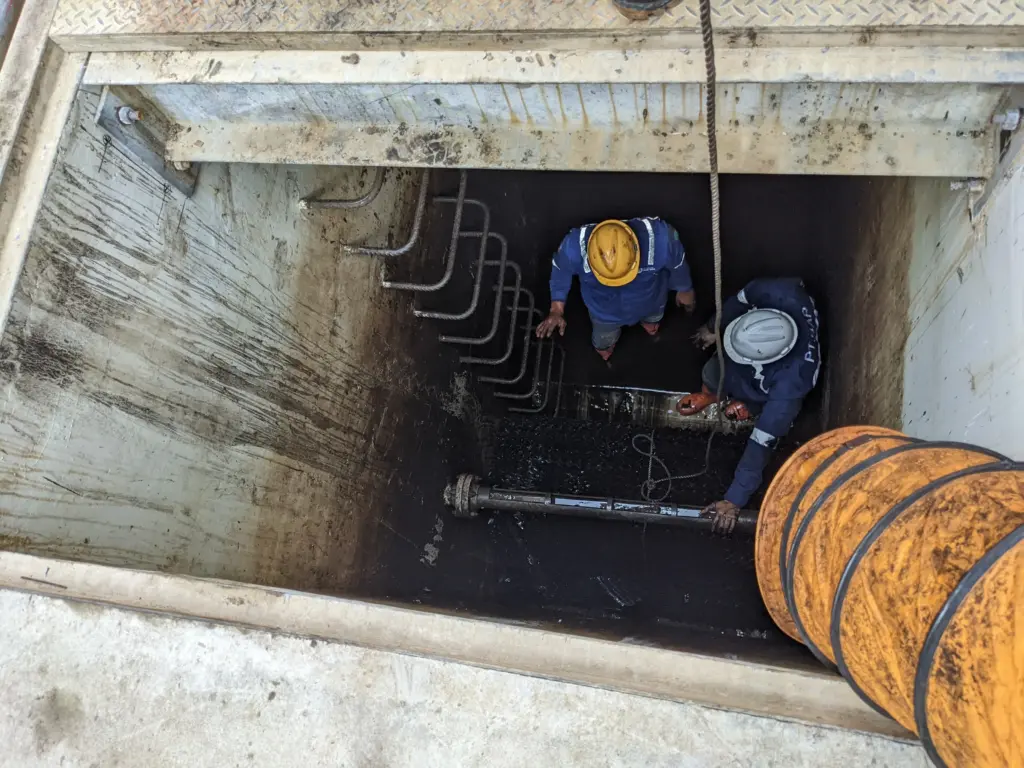
Confined space deaths are almost always preventable, and almost always come from skipping a step in a process everyone technically knew about. A tank, a pit, a vault gets treated as routine because the crew has been in and out of spaces like it a hundred times before, and the permit becomes paperwork filled out after the fact instead of a safety check done before.
Here’s what 29 CFR 1926 Subpart AA actually requires, and where that shortcut tends to happen.
What makes a space “confined” in the first place
A space is confined under OSHA’s construction standard if it meets three conditions: it’s large enough for a worker to physically enter and perform work, it has limited or restricted means of entry or exit, and it isn’t designed for people to occupy continuously. Tanks, silos, pits, vaults, and manholes are common examples, but the definition is about the physical characteristics of the space, not a fixed list of locations. A space your crew has never flagged before can still meet this definition the first time conditions change.
Before work begins at a site, a competent person is required to identify every confined space the crew might work in and determine which of those spaces are permit-required.
What makes it “permit-required”
Not every confined space needs a permit. A space becomes permit-required if it has any of the following: a hazardous atmosphere, material that could engulf someone who enters, an internal shape like sloping floors or tapered walls that could trap or asphyxiate a worker, or any other serious safety or health hazard.
This is where the atmosphere testing piece matters most. A space can look empty and still have displaced oxygen or trapped toxic gas that isn’t visible or obvious until someone’s already inside it. That’s exactly why testing happens before entry, not as a formality once someone’s already down there.
Who has to be involved
A compliant entry isn’t a one-person job. The standard defines specific roles:
Entry supervisor oversees the entry, confirms the permit is complete and conditions are safe, and has authority to cancel the entry if something changes.
Authorized entrants are the workers actually going into the space, and they need training on recognizing the hazards specific to that space and how to exit quickly if conditions change.
Attendants stay outside the space the entire time, monitor entrants, and are equipped to summon rescue immediately if something goes wrong. An attendant’s job is a dedicated task, not something handled between other duties.
On multi-contractor sites, there’s an added layer. The host employer has to share what it knows about permit spaces with the controlling contractor, and that information has to flow to every employer whose workers might enter the space. A confined space hazard that one contractor knows about but doesn’t pass along is exactly the kind of gap that leads to a fatality involving a crew that had no idea what they were walking into.
What the entry permit actually documents
The permit isn’t a signature confirming someone read a policy. It’s a working document specific to that entry, and it needs to include the space being entered, the hazards identified, the atmospheric test results, the names of the entry supervisor and attendants, the equipment required, and the rescue and emergency procedures in place for that specific entry.
If any of that information is generic or copied from a previous job’s permit without being verified for the current space and conditions, the permit isn’t doing its job. Conditions inside a permit space can shift between shifts, let alone between jobs.
If conditions change mid-entry
A permit-required space can sometimes be reclassified as non-permit if testing shows the hazards have been eliminated or isolated, but that reclassification can only be made by a competent person, and it only holds for as long as those hazards stay eliminated. If atmospheric conditions shift, or if anything suggests the original evaluation missed something, the space gets re-evaluated and, if needed, reclassified back to permit-required immediately. This isn’t a one-time decision made at the start of the job.
Where crews cut corners, and why it costs them
The most common failure point isn’t a missing document. It’s treating a familiar space as safe because it’s been entered before without incident. Every entry gets tested and evaluated on its own, because the same tank, pit, or vault can have different atmospheric conditions on different days depending on what’s been stored there, what work has happened nearby, or how long it’s been sealed.
Making this part of your safety program
Confined space entry is one of the areas where a checklist mentality creates real risk, because the permit process is designed to force a fresh evaluation every time, not to rubber-stamp a routine. If your crew regularly works around tanks, vaults, pits, or similar spaces, our OSHA Permit-Required Confined Space Safety for Construction and OSHA Permit-Required Confined Space Certification Training courses cover the full entry process, roles, and documentation requirements in detail.