

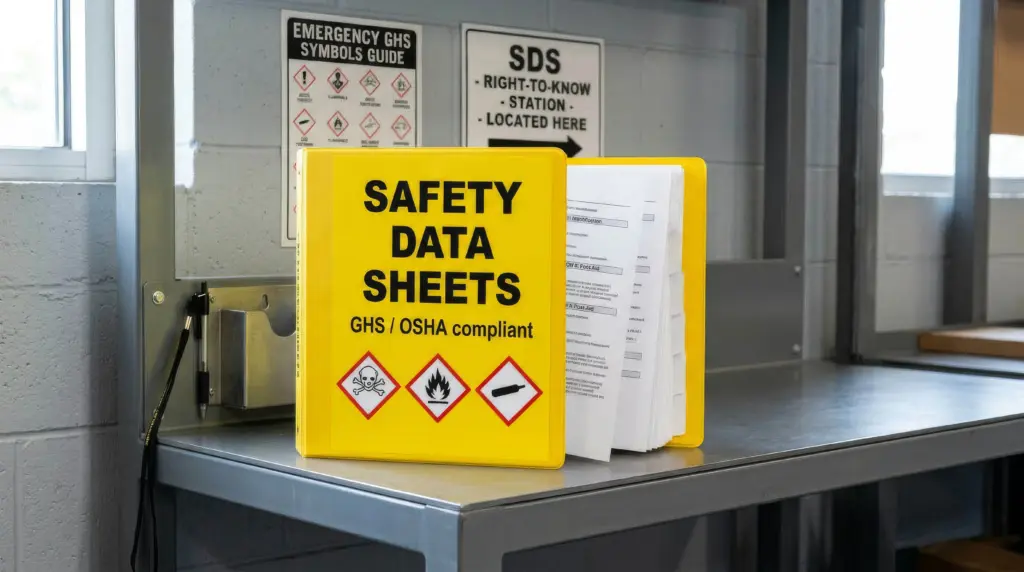
Hazard Communication has been OSHA’s second most-cited standard for years running — beaten out only by fall protection. That’s not because employers don’t know chemicals need labels and safety data sheets. It’s because HazCom compliance is a moving target of paperwork, supplier coordination, and training that’s easy to let slide until an inspector is standing in your storage room.
And right now, the target has actually moved. OSHA finalized an update to the Hazard Communication Standard back in 2024, and the deadlines tied to it are landing throughout 2026 — with a major one for employers arriving November 20, 2026. If your business stores, uses, or handles hazardous chemicals in any form, this affects you, even if nothing about your day-to-day work has changed.
What Actually Changed
OSHA’s updated standard aligns U.S. requirements with the 7th revision of the UN’s Globally Harmonized System (GHS) for classifying and labeling chemicals. In plain terms, that means:
- New hazard classifications — including chemicals under pressure and desensitized explosives — that didn’t exist as distinct categories before
- Updated Safety Data Sheet content, specifically Sections 2, 3, 9, and 11, with more detailed hazard and composition information
- More flexible labeling rules for bulk shipments, small packages, and containers released for shipment, since the old format didn’t fit every container size well
- Revised trade secret provisions, allowing concentration ranges instead of exact percentages in some cases
None of this changes the basic idea behind HazCom — workers still have a right to know what they’re working with and how to stay safe around it. What’s changing is the format and detail of that information, and the deadlines are why it matters right now.
The Deadlines That Matter to You
OSHA pushed the original 2026 deadlines back by four months in January 2026, so if you’ve seen conflicting dates floating around, the newer ones are correct:
- May 19, 2026 — chemical manufacturers, importers, and distributors were required to have updated substance labels and SDSs ready. This deadline has already passed, which means your suppliers should be sending you updated documentation now, if they haven’t already.
- November 20, 2026 — employers who use these substances must update workplace labels, written HazCom programs, and employee training to reflect the new information. This is the deadline that applies directly to most businesses reading this.
- November 19, 2027 and May 19, 2028 — later deadlines covering mixtures, which affect manufacturers first and then downstream employers.
The November date is the one to circle. It’s close enough that waiting until fall to start is cutting it tight, especially if your SDS library covers dozens of products across multiple suppliers.
What to Actually Do Between Now and November
Start collecting updated SDSs and labels from your suppliers. If a supplier hasn’t sent you anything new, ask. Manufacturers were required to have updated documentation ready as of May — a lack of proactive communication doesn’t mean nothing changed, it usually means you need to follow up.
Review your written HazCom program. It needs to reference the updated 2024 standard, not just the older HCS 2012 version, and reflect any new hazard classifications relevant to what you use on site.
Update your hazardous chemical inventory. Cross-check it against your current SDS library to make sure nothing on your site is missing documentation, updated or otherwise.
Build training into your fall schedule now. Once updated SDSs and labels come in, employees need to actually understand what changed — new pictograms, new hazard categories, new signal words. That’s a training requirement, not just a paperwork update, and it’s one of the areas OSHA inspectors check most closely.
Where Employers Usually Get Cited
HazCom violations tend to fall into a short list of repeat offenders:
- Written programs that exist but are outdated or incomplete
- SDS libraries with gaps — chemicals on-site with no corresponding sheet, or sheets nobody’s updated in years
- Labels that don’t match what’s actually in the container, especially after chemicals get transferred to secondary containers
- Training that happened once, years ago, with no refresh when products or hazard classifications changed
The pattern here is the same one that shows up across most OSHA citations: the plan exists somewhere, but it hasn’t kept pace with what’s actually happening on site. A HazCom program is only as good as its last update.
This Applies to Construction Just as Much as General Industry
If your business operates under 29 CFR 1926 rather than general industry rules, don’t assume this is a general-industry-only update. Construction’s hazard communication requirement, 1926.59, adopts the general industry standard in full — the regulation itself states that the requirements for construction work are identical to those in 1910.1200. There’s no separate construction version of this update and no separate timeline. The same May 19 supplier deadline and November 20 employer deadline apply whether you’re running a fabrication shop or a job site.
That’s worth flagging specifically because construction sites tend to have a wider mix of chemicals moving through them — job-site adhesives, coatings, fuels, welding consumables, cleaning products brought in by different subcontractors — which makes the SDS-library gap problem described above even easier to run into. If your crews handle chemicals covered under 1926 Subpart Z, it’s worth reviewing your HazCom training alongside your broader Subpart Z compliance, not as a separate task.
Don’t Wait for the Deadline to Feel Close
November 20 will arrive faster than it feels like it should, especially once you factor in supplier response times and the reality of getting training scheduled across a full crew. Getting ahead of it now — reviewing your inventory, chasing down updated documentation, and penciling in training dates — is a lot less painful than scrambling in October.
If your team needs a refresher on hazard communication fundamentals as part of this update, it’s worth folding into your regular training rather than treating it as a one-off box to check — whether that’s our General Industry Safety Training or our OSHA Hazard Communication (HazCom) Certification Training for construction crews, since both are governed by the exact same updated standard.