
Ask most crews to name the biggest hazard on a job site and you’ll hear “falls” almost every time. They’re not wrong — falls are the single largest cause of construction fatalities. But they’re only part of the picture. Struck-by and caught-in/between incidents round out OSHA’s “Fatal Four,” and together with electrocutions, these four hazard types account for well over half of all construction deaths every year.
Falls get the posters, the harness training, the stand-downs. Struck-by and caught-in/between hazards get comparatively little airtime — which is exactly the problem, because they’re not rare edge cases. They’re a steady, preventable cause of some of the worst injuries on any active site.
What the Numbers Actually Show
In 2024, more than a thousand construction workers lost their lives on the job. Falls accounted for roughly a third of those deaths, but struck-by incidents made up close to one in ten, and caught-in/between injuries added several percentage points on top of that. Combined with electrocution, these four categories together account for well over half of all construction fatalities in a given year.
The struck-by numbers carry a specific pattern worth knowing: approximately 75% of struck-by fatalities involve heavy equipment such as trucks or cranes. This isn’t a hazard driven mainly by hand tools or small falling debris — it’s overwhelmingly a hazard driven by vehicles and machinery moving around workers on foot.
Caught-in/between injuries follow a related but distinct pattern. These are the incidents where a worker gets pinned, crushed, or trapped between two objects, or caught in unguarded moving machinery — everything from equipment interaction to trench collapses falls into this category.
Why These Two Get Lumped Together (and Why That Matters)
Struck-by and caught-in/between are closely related — a worker can be struck by an object and then caught between it and something else in the same incident. The practical distinction: if the impact of an object alone causes the injury, it’s struck-by; if a worker ends up crushed or trapped between two surfaces or objects, it’s caught-in/between, even if a strike happened first.
That overlap matters because it means prevention for both hazards often comes down to the same root cause: workers and moving equipment or materials occupying the same space at the same time, without a clear system for keeping them apart.
The Common Threads Behind Both Hazards
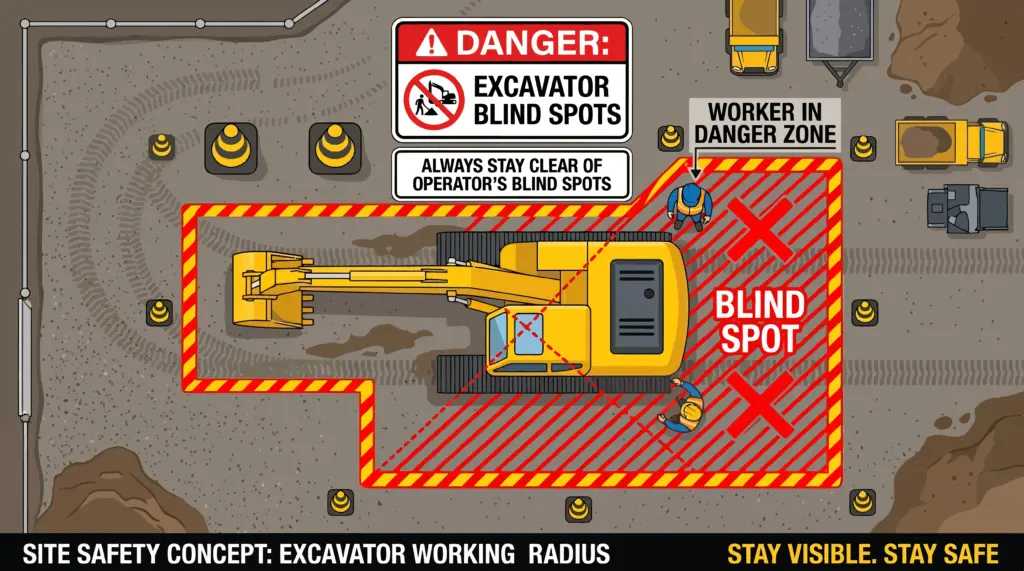
Blind spots and line-of-sight gaps. Operators can’t always see workers on foot, especially around the rear and sides of heavy equipment. Most struck-by-vehicle incidents trace back to a moment where the operator didn’t know someone was there.
Unguarded moving machinery. Rotating parts, conveyor systems, and equipment without proper guarding are a recurring source of caught-in incidents, particularly for workers who weren’t part of the original equipment setup and don’t know where the pinch points are.
No clear separation between work zones and travel paths. When foot traffic and equipment traffic share the same space without barricades, spotters, or defined paths, it’s a matter of when, not if, someone ends up in the wrong place at the wrong moment.
Rushed or informal equipment interaction. A lot of these incidents happen during routine, repeated tasks — backing up, repositioning, swinging a load — precisely because familiarity breeds a shortcut around the formal signal-and-clearance process.
A 5-Minute Pre-Task Huddle for Struck-By and Caught-In Risk
Before equipment moves or workers enter an area with active machinery, run through this with the crew:
- What’s moving in this area today — vehicles, cranes, conveyors, swinging loads — and who’s on foot near it?
- Does every operator have a clear line of sight to workers on foot, or is a spotter needed?
- Are there defined travel paths separating foot traffic from equipment traffic?
- Is all moving machinery properly guarded, including anything temporary or recently set up?
- What could cause a serious injury today if this task goes wrong — not just “what’s the procedure,” but where’s the actual energy that could hurt someone?
- Does everyone know the signal or communication method for equipment starting, backing up, or repositioning?
That last question is worth emphasizing during huddles: informal hand waves and assumptions are where a lot of these incidents start. A clear, agreed-upon signal system, actually followed every time, closes a gap that catches experienced crews as often as new ones.
Building This Into Your Regular Training, Not Just a One-Time Talk
Struck-by and caught-in/between hazards don’t go away because a crew has done the work before — familiarity is often what erodes the caution that prevented the incident the first hundred times. Refreshing this training periodically, especially any time equipment, crew composition, or site layout changes, keeps the awareness sharp instead of letting it fade into routine.
If your team could use a refresher on equipment interaction and jobsite hazard awareness as part of your regular training cadence, it’s worth building into your broader OSHA Construction Training or General Safety Industry Training rather than treating it as a one-off toolbox talk.