

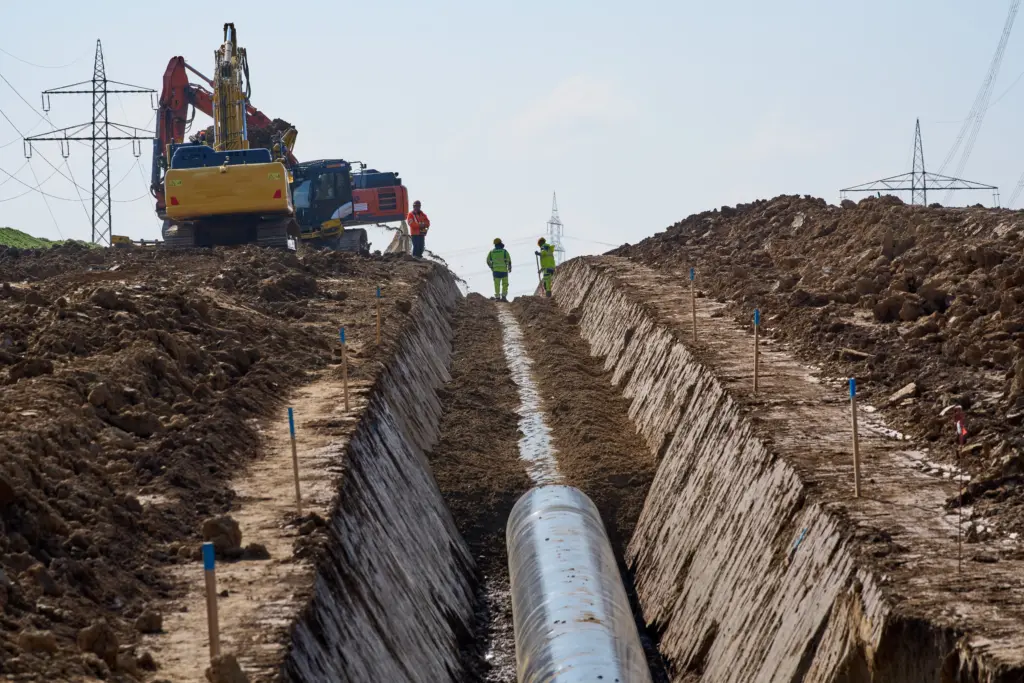
A single cubic yard of soil can weigh as much as a small car. When a trench wall collapses, workers don’t get a warning — they get buried in seconds, under a force that first responders often can’t dig through fast enough to save them.
That’s why trenching and excavation sit near the top of OSHA’s list of highest-fatality hazards, right alongside falls. And it’s why 2026 has seen a renewed push around it: contractor associations have been running trench and excavation stand-downs with OSHA, reviewing requirements and running rescue demonstrations on active jobsites. If your crew touches utility work, foundations, pipelines, or any kind of underground work, this is worth a closer look — even if you think you already know the basics.
Why Trenching Gets Deadlier the More “Routine” It Feels
Falls get talked about constantly on jobsites. Trenching doesn’t get the same airtime, partly because a lot of excavation work looks routine — dig a trench, run the line, backfill, move on. That routine is exactly what makes it dangerous. Cave-ins happen fast, often with no visible warning sign beforehand, and workers inside a trench have almost no ability to get out of the way once soil starts to move.
OSHA’s standard exists because of this specific risk profile: it’s not a hazard you can manage by “being careful.” It requires systems, inspections, and a person on-site whose job is specifically to catch problems before they become collapses.
What the OSHA Excavation Standard Actually Requires
The core requirements under 29 CFR 1926 Subpart P break down into a few key pieces:
A competent person on-site. Every excavation needs someone qualified to identify existing and predictable hazards, and who has the authority to stop work and fix them. This isn’t a title you assign once — it’s a role that requires ongoing training and the judgment to make a call in the field.
Daily inspections. Trenches need to be inspected by the competent person before work begins each shift, after any rainfall or other event that could affect stability, and whenever conditions change. A trench that was safe yesterday isn’t automatically safe today.
Protective systems for trenches 5 feet or deeper. This is where most violations happen. Depending on soil type and depth, that means sloping, benching, shoring, or a trench box (shield). There’s no “we’ll just be quick” exception — depth and soil classification determine the requirement, not how long the work will take.
Safe access and egress. Any trench 4 feet or deeper needs a ladder, ramp, or other exit within 25 feet of every worker, so people can get out fast if conditions start to change.
Keeping spoil piles back. Excavated soil and equipment need to stay at least 2 feet from the edge of the trench. A spoil pile too close to the edge adds weight exactly where the wall is already under stress.
Where Contractors Actually Get Cited
The pattern in enforcement is consistent: it’s rarely a total absence of a plan. It’s usually a gap between the paperwork and what’s happening in the trench.
- A protective system rated for the wrong soil classification
- A competent person designated on paper but not actually present or checking conditions
- Spoil piles or heavy equipment staged too close to the edge
- No egress within reach when workers are deep in a run
- Skipping the re-inspection after a rain event, assuming yesterday’s check still counts
None of these come from a lack of general safety awareness. They come from treating trenching like a task to complete rather than a hazard to actively manage, shift by shift.
Trenches vs. Confined Spaces: Where the Line Blurs
A question that comes up a lot on jobsites: is a trench a confined space? The short answer is usually not — OSHA specifically excludes excavations from its permit-required confined space construction standard (29 CFR 1926.1201(b)(1)). Trenches are regulated under the excavation standard instead, which is why the requirements above focus on cave-in protection, not atmospheric monitoring or permit entry procedures.
But “usually not” isn’t “never.” A trench can cross into confined space territory when:
- Hazardous atmospheres are possible — work near landfills (methane), leaking underground storage tanks, or areas with known gas lines
- A worker needs to enter a manhole, pipe, or vault at the bottom of the excavation — that structure is covered by the Confined Spaces in Construction standard (1926 Subpart AA), even though it sits inside an open trench
- The trench is deep and narrow with limited egress, resembling the entry/exit restrictions that define a confined space, even if it doesn’t technically meet OSHA’s definition
This is exactly the kind of overlap that trips crews up — the excavation standard doesn’t require atmospheric testing by default, but if there’s any reasonable chance of a hazardous atmosphere, that testing becomes necessary, and the procedures start to look a lot like confined space entry. If your crews regularly do utility work, pipeline tie-ins, or anything involving underground structures at the bottom of a trench, it’s worth having them trained on confined space recognition and entry procedures in addition to excavation competent-person training — the two hazards show up together often enough that treating them as separate boxes to check can leave a real gap.
A Pre-Shift Trench Safety Checklist
Print this or run through it verbally at your morning huddle before crews enter any trench:
- Has the competent person inspected the trench today — not yesterday, not at the start of the job?
- Has it rained, or has anything else changed since the last inspection? If yes, re-inspect before anyone enters.
- Is the protective system rated for the actual soil type and depth, not just “what we usually use”?
- Is there a ladder or ramp within 25 feet of every worker in a trench 4 feet or deeper?
- Are spoil piles and equipment at least 2 feet back from the edge?
- Does everyone entering know the emergency exit and rescue plan before they step down?
- Could this trench involve a hazardous atmosphere or a manhole/pipe/vault entry? If so, confined space entry procedures apply in addition to excavation requirements.
If the answer to any of these is “no” or “not sure,” that’s the signal to stop and fix it before work starts — not after.
Building a Culture Where This Actually Gets Followed
A checklist only works if crews feel safe using it — including feeling safe to say “hold on” when something looks off, even under schedule pressure. That’s a leadership issue as much as a technical one. The most consistent trenching safety records tend to belong to crews where the competent person’s word overrides the timeline, every time, no exceptions.
If your team handles excavation work regularly, it’s worth building trench safety refreshers into your regular training cadence — not as a one-time certification, but as something revisited whenever crew composition, equipment, or job sites change.