

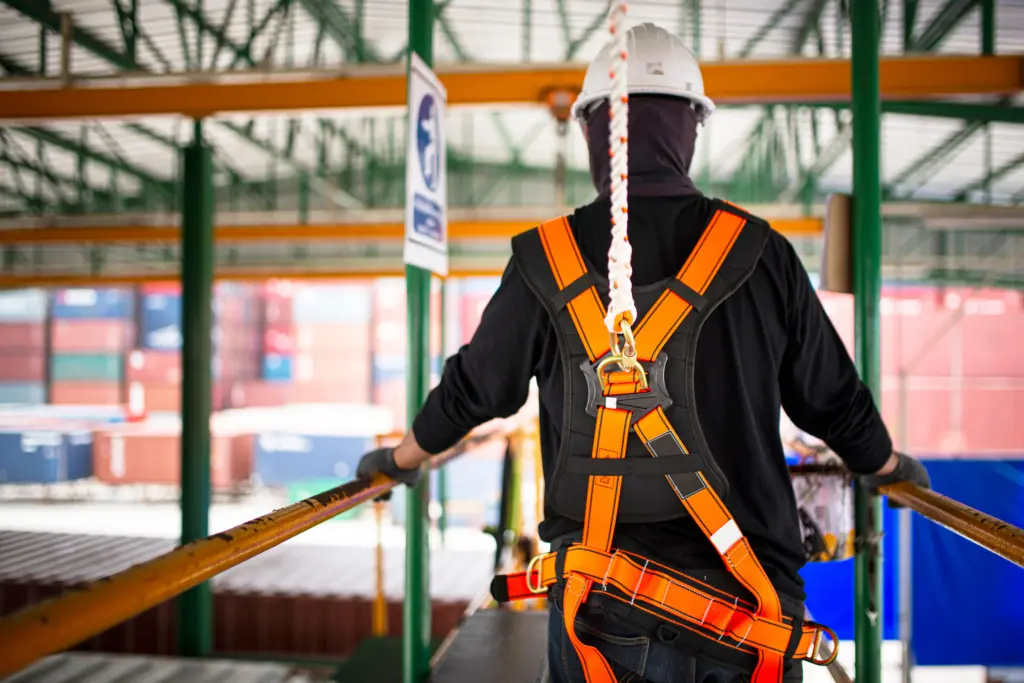
Fall protection is required in construction any time a worker is six feet or more above a lower level. That single number, six feet, is the trigger that decides whether guardrails, nets, or a personal fall arrest system need to be in place before anyone steps onto that surface. It sounds simple. In practice, it’s the most cited OSHA violation in construction every year, which means many crews get the details wrong.
Here’s what the rule actually covers, what counts as compliant, and where most citations come from.
At what height is fall protection required?
Under 29 CFR 1926.501, construction workers need fall protection at six feet or more above a lower level. This applies to unprotected sides and edges, leading edges, floor and wall openings, formwork, rebar assemblies, and roofing work. It’s a lower threshold than general industry, which uses a four-foot trigger for some situations and different rules for others. If your crew moves between residential, commercial, and industrial sites, don’t assume the same height rule follows you. Confirm which standard applies to the specific job.
Excavation work has its own related trigger. If a walking surface sits adjacent to an excavation, that also falls under the fall protection duty, separate from the trench-specific requirements. If your crew works excavation and trenching regularly, it’s worth reviewing how that overlaps with trench and excavation safety requirements.
What counts as an OSHA-compliant fall protection system?
OSHA accepts a few categories of systems, and the right one depends on the task:
| System | What it does | Best used for |
|---|---|---|
| Guardrails | Passive barrier along an open edge | Fixed elevated surfaces, floor openings |
| Safety net systems | Catches a fall below the work surface | When guardrails or PFAS aren’t practical |
| Personal Fall Arrest System (PFAS) | Harness, lanyard, and anchor point that stops a fall in progress | Roofing, steel erection, leading edge work |
| Positioning and travel restraint | Keeps a worker from reaching the fall edge at all | Work near an edge where reaching it isn’t necessary |
Travel restraint is worth calling out because it’s often confused with fall arrest, but it works differently. Restraint keeps a worker from ever getting close enough to the edge to fall. Arrest catches them after they’ve already gone over. OSHA increasingly favors restraint where it’s practical because it prevents the fall entirely instead of managing the consequences.
Any PFAS in use needs a full inspection before each use. Equipment that has arrested a fall, even once, has absorbed forces that compromise its future performance. It gets tagged out of service immediately, not reused until “it looks fine.”
What training is required before working at height?
Under 1926.503, workers must be trained by a competent person before working in conditions with fall hazards. That training must cover how to recognize job-specific fall hazards, how to use the fall protection systems assigned to them, and what the site’s rescue plan is if a fall arrest system is activated.
That last piece gets skipped more often than it should. If a PFAS catches a fall, the worker is now suspended in a harness, and suspension trauma can set in within minutes. A rescue plan isn’t a nice-to-have. OSHA requires it to be documented, practiced, and ready before anyone ties off.
Where crews get cited most
A few patterns show up consistently in OSHA’s enforcement data:
Residential roofing without a personal fall arrest system. Roofing remains the most cited category under 1926.501, often because workers tie off only after guardrails or anchor points are already set up, not during setup.
Unprotected leading edges. Workers installing decking, sheathing, or roofing along an edge that has no guardrail or net in place. The leading edge standard requires protection unless it’s genuinely infeasible, and infeasibility isn’t a judgment call made on-site. 1926.502 (k) requires a written fall protection plan.
Floor and hole covers that don’t meet spec. Covers over floor openings need to support twice the maximum load they might see, be secured against shifting, and be labeled or color-coded so nobody mistakes them for solid flooring.
What if fall protection is genuinely infeasible?
Occasionally a task makes conventional fall protection impractical. OSHA doesn’t treat “it’s difficult” as infeasible. It requires a written fall protection plan that documents why standard systems can’t be used for that specific task and what alternative measures are in place instead. That plan needs to be site-specific, not a generic form pulled from a binder. If your crew regularly hits tasks like this, it’s worth building the plan template before the job starts, not while an inspector is standing on-site asking for it.
Building this into your safety program
Fall protection compliance isn’t a one-time training checkbox. It’s height triggers, system selection, pre-use inspection, and rescue planning working together, and it needs a refresher any time your crew takes on a new type of elevated work. If your team is due for a refresher or you’re onboarding workers who haven’t had formal training yet, our OSHA Construction Fall Protection Training covers fall protection requirements in depth alongside the other high-risk areas construction crews are cited on most.