

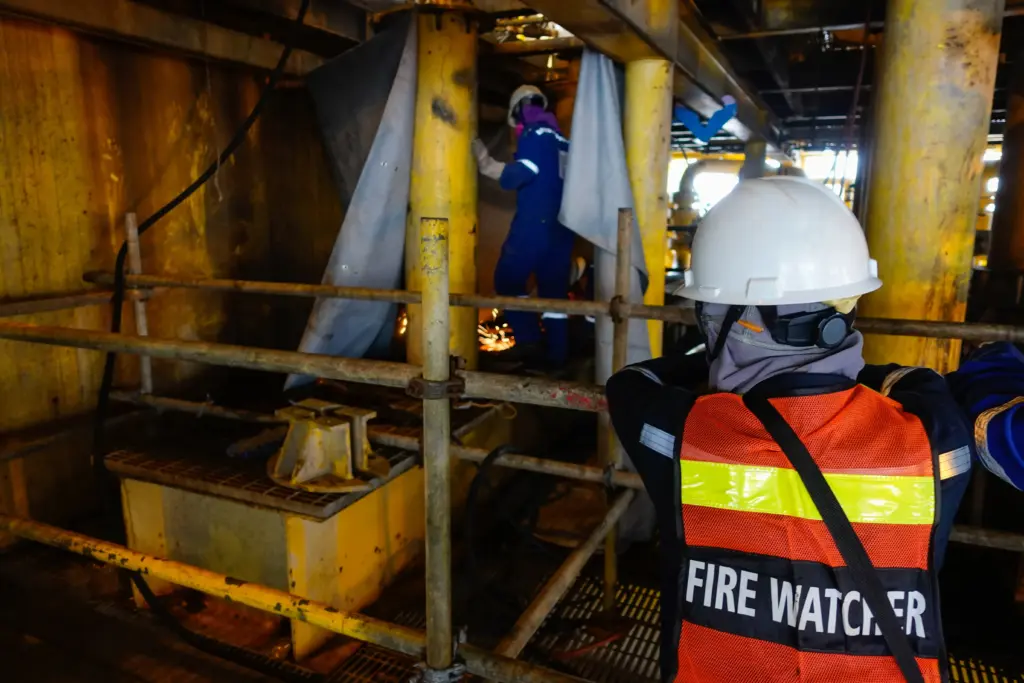
Welding, cutting, grinding, and brazing account for a large share of construction site fires. Most of those fires start the same way. A spark or piece of slag lands somewhere it shouldn’t, smolders unnoticed, and ignites minutes or hours after the work is done, and everyone has moved on.
A hot work permit system exists to prevent exactly that. When it’s treated as paperwork rather than a real control, the risk doesn’t go away. It just moves further from anyone’s attention.
What Counts as Hot Work
Hot work covers any task that produces heat, sparks, or an open flame that could ignite nearby materials. That includes welding, cutting, grinding, soldering, and brazing. On an active construction site, work often occurs near combustible materials that weren’t a factor when the space was originally designed, such as insulation, packaging, dust, or temporary coverings.
What a Real Permit System Requires
A hot work permit isn’t just a signature confirming the job happened. It documents a few specific things before work starts:
- The area has been inspected for combustible materials within 35 feet of the work.
- Combustibles that can’t be moved are covered with a fire-resistant material.
- A fire extinguisher is on hand, and someone present knows how to use it.
- A dedicated fire watch is assigned for the duration of the work and for a set period afterward, since smoldering material can ignite well after the torch is off.
What “I’ll Just Watch for Sparks” Gets Wrong
On a busy site, fire watch duty is often treated as something anyone nearby can half-do while also doing something else. That’s not what the role requires. A fire watch has one job: staying in the area, watching for ignition, and knowing how to respond immediately if something starts smoldering. A fire watch who’s also running material to another part of the site, checking their phone, or splitting attention between two tasks isn’t providing the control the permit assumes is in place.
The same principle applies here as with any other energy or hazard control we’ve covered, including lockout and tagout on energized equipment. A control that exists on paper but isn’t actually followed in practice provides no real protection.
After the Torch Is Off
This is where most hot-work fires start. Slag and sparks can smolder in insulation or debris for a significant amount of time before catching. A fire watch needs to stay in the area for a defined period after work finishes, not leave the moment the welding stops. If your crew doesn’t have a clear standard for how long the watch period should last, it’s worth setting one explicitly rather than leaving it to individual judgment.
Coordinating With Other Site Hazards
Hot work rarely happens in isolation from other hazards on a site. If the area has recently had chemical exposure controls in place, it’s worth checking your HazCom labeling and SDS documentation before assuming a space is clear for hot work. Some materials that are safe under normal conditions become a serious hazard when heat is introduced.
Building the Habit
A hot work permit system works when crews understand why each step exists, not just that a signature is required. If your team needs a refresher on permit requirements, fire watch responsibilities, or how to handle hot work in spaces with limited visibility, our Hot Work Safety Training covers the requirements and practical procedures crews can use on an active job site.