

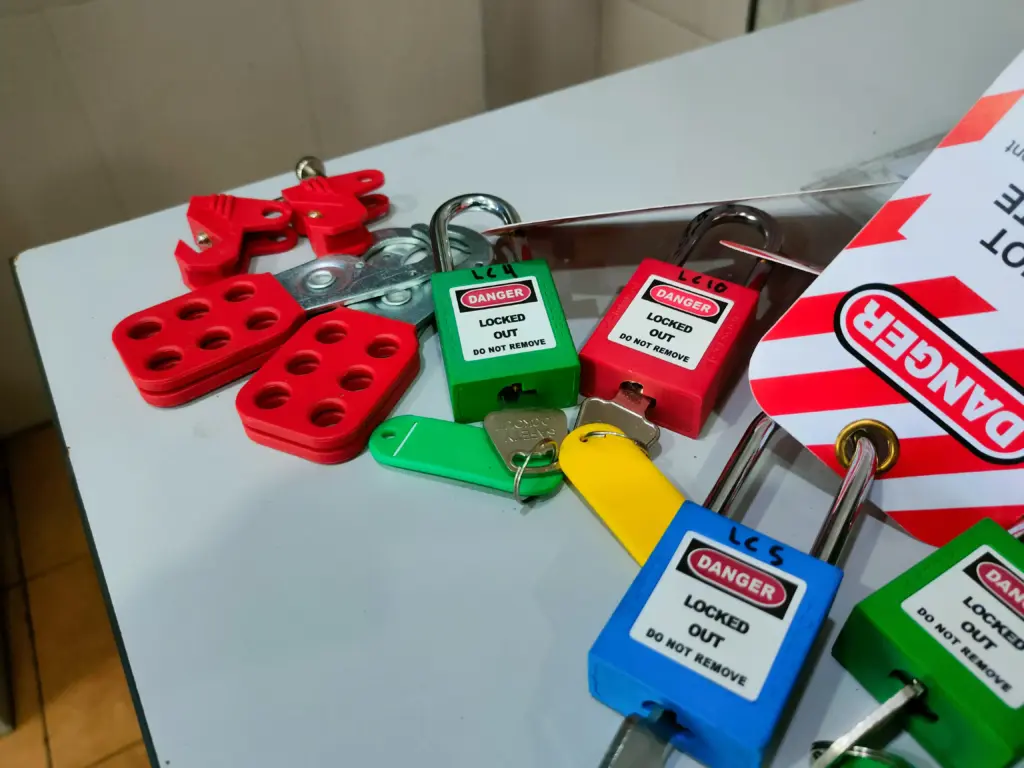
Ask most construction crews if lockout/tagout applies to them, and a lot will say no. LOTO is a factory thing. The yellow padlocks on a stamping press, the tag on a conveyor belt. Not something that applies to a job site.
That assumption is wrong, and it’s a dangerous one. Every year, unexpected energization or the release of stored energy (electrical, mechanical, hydraulic, pneumatic) puts construction workers in the hospital or the morgue. The fix usually takes less than two minutes. Skipping it is one of the most preventable ways to lose a worker.
LOTO in Construction Isn’t the Same Rule as LOTO in a Factory
Here’s where a lot of confusion starts. The general industry lockout/tagout standard, 29 CFR 1910.147, is the one most people picture when they hear “LOTO.” It’s detailed, comprehensive, and covers the control of hazardous energy on machinery broadly. But 1910.147 doesn’t directly regulate construction activity.
Construction has its own, narrower standard: 29 CFR 1926.417, Lockout and Tagging of Circuits, which lives in Subpart K (Electrical). In plain terms, it says that any control governing power delivery to equipment or circuits must be tagged if it’s deactivated for work, and that de-energized equipment must be “rendered inoperative,” not just switched off, but physically incapable of restarting (think: fuse pulled, plug disconnected, not just a breaker flipped). Tags have to go on every point where the equipment could be re-energized.
Because 1926.417 is narrower and electrical-specific, many contractors also apply the 1910.147 control-of-hazardous-energy principles as best practice for other energy sources, hydraulic lines, pneumatic systems, stored mechanical energy in equipment like scaffolding hoists or gate operators. There isn’t one clean construction-wide standard for every type of hazardous energy the way there is in general industry, which is exactly why LOTO gets treated as optional on some sites. It isn’t. Related energy-control requirements also show up in Subpart Q (concrete and masonry equipment, 1926.702(j)) and Subpart AA (confined spaces, 1926.1206), so a single project can touch multiple lockout provisions without anyone flagging it as “the LOTO section.”
What Skipping It Looks Like
On a real site, the skip rarely looks like a conscious decision. It looks like:
- A breaker gets flipped off, but no one tags it, so a second crew flips it back on without knowing someone’s mid-repair
- “De-energized” means unplugged, but the plug is still sitting right there for anyone to grab
- A hydraulic arm is lowered but not blocked, and gravity does the rest when a seal fails
- Verbal handoffs (“hey, don’t touch that”) replace a physical tag because the job’s supposed to take five minutes
Every one of these has ended in a serious injury somewhere. The standard exists because verbal agreements don’t survive a shift change, a new hire, or a distracted moment.
What a Real LOTO Procedure Looks Like on a Job Site
- Identify every energy source. Electrical is the obvious one, but don’t forget hydraulic, pneumatic, gravity, and stored mechanical energy.
- Notify affected workers before shutting anything down.
- De-energize and render inoperative. Turning something off is step one. Physically preventing it from turning back on is the actual requirement.
- Apply the lock or tag at every point of re-energization, not just the main disconnect.
- Verify. Test that the equipment truly can’t operate before anyone puts hands on it.
- Only the person who applied the lock or tag removes it, once work is fully complete.
This should feel familiar if your crews have gone through excavation competent-person training, where the same logic applies: identify the hazard, control it physically, verify before anyone’s exposed. We covered that same principle in our trench and excavation safety piece; protective systems aren’t optional just because the job looks quick.
Why This Keeps Showing Up on Citation Lists
Hazardous energy control incidents share a pattern with the SDS and labeling gaps we broke down in our HazCom 2026 update: the hazard isn’t dramatic until the moment it is. Both come down to the same failure mode: a control that exists on paper but isn’t actually followed in the field, usually because the crew was never trained on why it matters, not just what to do.
Build the Habit, Not Just the Paperwork
A written LOTO procedure that sits in a binder doesn’t protect anyone. What protects workers is a crew that automatically reaches for a lock or tag the same way they reach for a hard hat, because they understand what’s actually at stake if they don’t. A five-minute toolbox talk the week your crew is working near energized equipment is one of the simplest ways to make that habit stick. See our piece on running a toolbox talk workers actually listen to for how to structure one that lands.
If your team needs a refresher, or you’re bringing on new hires who’ve never had formal energy-control training, our OSHA Lockout/Tagout Safety for Construction Training walks through the 1926.417 requirements along with practical, field-level procedures your crews can actually use.